Skip to content
SSNERI — Shodh Sansthan Neri

Itihas Divakar

January 2010

January 2010Edited by Dr. Vidya Chand ThakurVol. 2, Issue 4
Cover of January 2010
Download PDF

PDF · 3.5 MB · opens in a new tab

In This Issue

This issue of Itihas Divakar focuses on topics such as the historical reasons for the partition of India, the spread of Indian culture in Southeast Asia, and the importance of cattle wealth in Panini's Ashtadhyayi. It also includes articles on the life and philosophy of Maharshi Kanada, science in Hindu mythological tales, and the cultural significance of the cow. The journal provides a research-oriented perspective on Indian history, culture, and ancient knowledge.

Key Highlights

  • 01This issue analyzes the root causes of India's partition, highlighting the false 'Three Sister Communities' theory proposed by the British as a major historical factor.
  • 02A detailed account of the profound cultural influence of the Ramayana, the Sanskrit language, and the Hindu way of life in Southeast Asian countries like Thailand, Cambodia, and Indonesia.
  • 03Highlights the importance of 'Godhan' (cows and cattle wealth) in Indian culture and economy, with reference to Maharishi Panini's 'Ashtadhyayi'.
  • 04An introduction to the life of the ancient Indian sage Maharshi Kanada and his 'Vaisheshika' philosophy, which includes the concept of atomic theory.

Contributors

Editor
Dr. Vidya Chand Thakur
Author
Vishwa Mohan Tiwari
P. G. Sahasrabuddhe
Vasudeva Poddar
Dr. Kuldeep Agnihotri
Thakur Ram Singh
Co-Editor
Chetram Garg

Topics

  • Ancient India
  • Hindu Philosophy
  • Indian Culture
  • Partition of India
  • Science and Religion
  • Southeast Asia

About the Journal

Itihas Divakar (The Lamp of History) is our flagship quarterly research journal dedicated to illuminating the rich tapestry of Indian history. Each issue contains scholarly articles, research papers, and analyses based on authentic sources in Hindi, Sanskrit, and other Indian languages.

The journal serves as a platform for researchers and scholars to present their findings on various aspects of Indian history, culture, and civilization, contributing to a more comprehensive understanding of India's glorious heritage.

View All Archive

Itihas Divakar

July 2010

Vol. 3Issue 2July 2010
  • Culture
  • Himachal Pradesh
  • Indian History
  • +6

This July 2010 issue of "Itihas Diwakar" focuses on diverse aspects of Indian history, culture, and religion. It features detailed articles on topics such as the social contributions of saints, the valor of national protectors like Maharaja Suheldev, the history of the Katoch dynasty of Trigarta, and the worship of Naga deities in Himachal Pradesh. Additionally, it analyzes the mythological story of Goddess Sati, the contributions of the ancient architect Vishwakarma to Shilpa Shastra, and a folktale related to Vishnu.

Read Abstract
Itihas Divakar

April 2010

Vol. 3Issue 1April 2010
  • Astrology
  • Chronology
  • Culture
  • +4

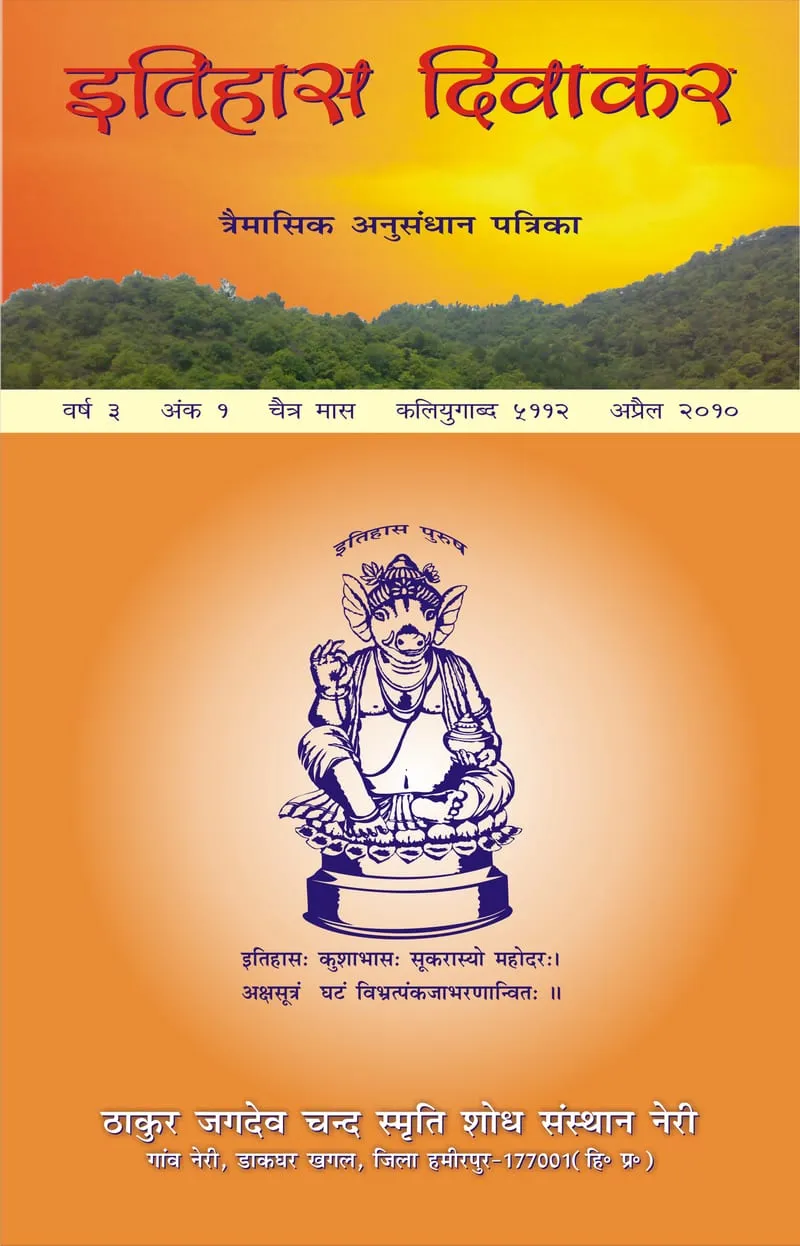
The April 2010 issue of 'Itihas Diwakar' focuses on Indian history, culture, and chronology. It analyzes the scientific and cultural significance of Chaitra Shukla Pratipada (Nav Samvatsar), the contributions of Varahamihira, one of Vikramaditya's nine gems, and the valor of Maharana Pratap in Haryanvi folk tales. The issue also sheds light on the historical efforts and contemporary challenges of Hindu-Muslim dialogue in India.

Read Abstract

Itihas Divakar

July 2009

Vol. 2Issue 2July 2009
  • Chronology
  • Culture
  • Hindu-Buddhist Relations
  • +4

This publication is the July 2009 issue of 'Itihas Diwakar', a quarterly research journal. It contains various articles focusing on Indian history, culture, and philosophy. Key topics include the centenary of Sri Aurobindo's Uttarpara speech, an address by Mohan Rao Bhagwat on the nature of history, and an analysis of the Puranic timeline of 'Shvetavaraha Kalpa'. Additionally, it features articles on the reality of Noah's flood, Hindu-Buddhist relations, Hammir Chauhan of Ranthambore, and the festival of Shravani Purnima. The journal aims to present Indian history from a traditional and nationalist perspective.

Read Abstract

Itihas Divakar

April 2009

Vol. 2Issue 1April 2009
  • Chronology
  • Culture
  • Indian History
  • +3

This April 2009 issue of 'Itihas Diwakar' is a quarterly research publication. It primarily focuses on the significance of the Indian New Year, 'Varsh Pratipada'. Various articles discuss the scientific and cultural relevance of Indian calendar systems like Vikrami, Shak, and Kaliyugabd. Additionally, it sheds light on topics such as the historical reasons for Prithviraj Chauhan's defeat and the nature of Jihadi terrorism prevalent in India, making it a comprehensive blend of history, culture, and contemporary issues.

Read Abstract

Stay Connected

Join our scholarly network for updates on research and events.