01
Devotion to "Lok Jivan"
Dr. Vidya Chand believed that the true culture of a nation is expressed through its folk life.
"If we have to choose between the scripture and the folk, the folk gets the first priority."

Dr. Vidya Chand Thakur
A profound scholar and the intellectual force who translated the institute's historical vision into tangible research, always championing the wisdom of folk traditions.
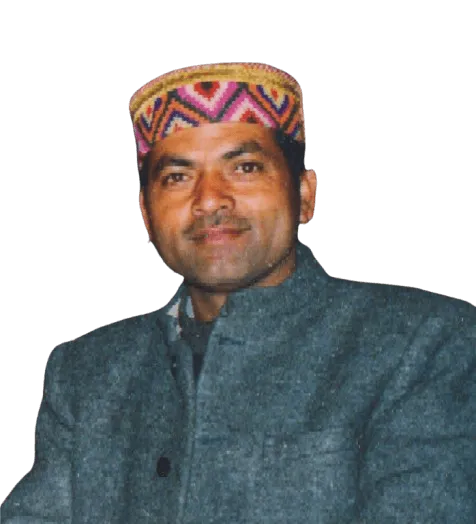
Dr. Vidya Chand believed that the true culture and thought of a nation are expressed through its folk life. He often said, "If we have to choose between the scripture and the folk, the folk gets the first priority." This belief guided his lifelong path of study.
Biography
1953
Born on January 13, 1953, in the village of Khoda Aage, Kullu, Himachal Pradesh. He lost his father at the age of 8 and was raised by his mother, Lotmi Devi. He was a brilliant student from a young age.
Academics
His academic journey was marked by excellence, culminating in a Ph.D. with a gold medal from Himachal University. He was later appointed as the District Language Officer in the Department of Language, Art, and Culture of Himachal Pradesh.
1988 onwards
Dr. Vidya Chand, alongside Thakur Ramsingh Ji and Chetram Ji, formed the "trinity" of the research institute. While Thakur Ramsingh Ji provided the vision and Chetram Ji managed the external affairs, Dr. Vidya Chand was the one who gave concrete shape to the intellectual and research work.
2017
Deeply dedicated to his work, he served as the editor of the institute's quarterly magazine, 'Itihas Diwakar'. Even after retirement, he devoted his time to research and writing for the institute. He passed away on October 31, 2017, leaving behind a rich legacy of scholarship.
Philosophy
A scholar who found the deepest truths not just in books, but in the soil and soul of the people.
01
Dr. Vidya Chand believed that the true culture of a nation is expressed through its folk life.
"If we have to choose between the scripture and the folk, the folk gets the first priority."
02
Despite his high academic achievements, he lived a simple, rustic life. He preferred his ancestral home and found joy in farming tasks, seeing them as a form of daily exercise and connection to his roots.
The Founding Trinity
The founder whose vision this scholarship serves.
Read onThe organiser who built the institution at Neri.
Read onThe quarterly journal he edits.
Read onJoin our scholarly network for updates on research and events.